Prefabricated Bathroom Pods for Hospitals: Solving a Construction Problem Few People Talk About
|
Summary :
|
When hospital projects fall behind schedule, the cause isn't always what people expect.
It's easy to blame structural work, permitting issues, or material shortages. Those certainly play a role. But on many healthcare projects, delays often show up in smaller spaces that require a surprising amount of coordination.
Bathrooms are one of them.
A patient bathroom may occupy only a fraction of the floor plate, yet dozens of decisions and installations happen inside that footprint. Plumbing needs to line up perfectly. Electrical systems need to be coordinated. Accessibility requirements must be met. Finishes have to withstand years of daily use. Then everything gets inspected.
Multiply that by 100 or 200 bathrooms across a hospital project, and the complexity becomes obvious.
That reality is one reason developers, healthcare systems, and contractors are taking a closer look at prefabricated bathroom pods for hospitals.
A Hospital Bathroom Is More Complicated Than It Looks
Most people see a sink, a toilet, a shower, and a few grab bars.
Construction teams see something different.
Behind every wall sits a network of systems that must work together from day one. If a plumbing rough-in is off by an inch, another trade may need to adjust its work. If waterproofing gets delayed, finishes get delayed. If inspections don't happen on time, occupancy gets pushed back.
None of these issues is catastrophic on its own.
The problem is repetition.
What happens once in one room can happen fifty times across a project.
That's where bathroom pods entered the conversation.
The Idea Is Actually Pretty Simple
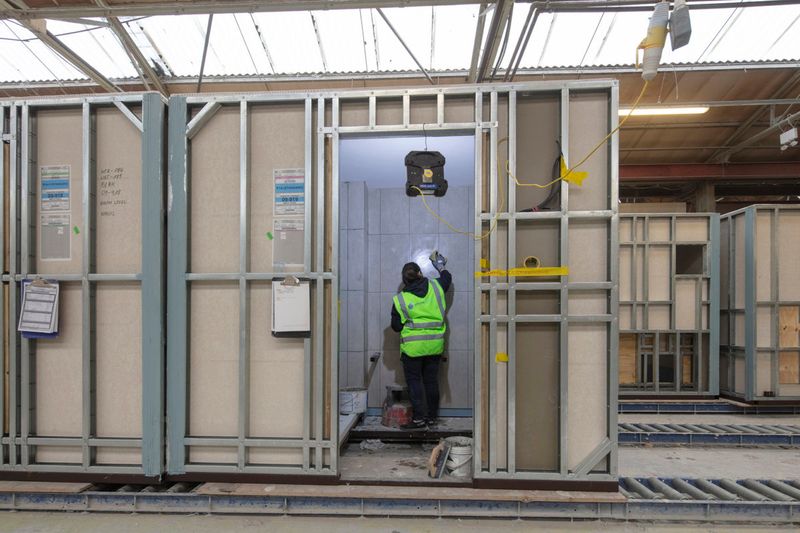
Instead of treating every bathroom as its own construction project, the bathroom is built elsewhere.
The plumbing is installed. The fixtures are fitted. Electrical work is completed. Finishes are applied.
Then the entire unit arrives ready for placement.
It sounds straightforward because it is.
The value isn't necessarily in doing something revolutionary. It's in removing hundreds of small coordination tasks that typically happen on-site.
Project teams spend less time managing bathroom construction and more time focusing on the building as a whole.
The Quality Discussion Matters More Than the Speed Discussion
Most conversations about modular construction start with schedule savings.
That's understandable.
Healthcare projects are under constant pressure to open sooner, especially when expanding patient capacity.
But many project teams who have used prefabricated bathroom pods for hospitals point to something else first: consistency.
Building one good bathroom isn't particularly difficult.
Building hundreds that all look, function, and perform the same way is much harder.
Factory production creates an environment where the same process is repeated again and again. Materials are stored in one place. Installation methods remain consistent. Inspections happen throughout production.
The outcome tends to be more predictable.
And in healthcare construction, predictability is valuable.
Labor Shortages Have Changed the Conversation
A decade ago, many owners viewed modular construction as an alternative approach.
Today, it's increasingly viewed as a practical response to labor realities.
Finding skilled trades isn't getting easier.
Plumbers, electricians, finish specialists, and installers remain in high demand across the construction industry. Hospital projects often compete with commercial, residential, industrial, and infrastructure developments for the same labor pool.
That competition creates scheduling pressure.
Bathroom pods don't eliminate labor needs.
They simply move much of that labor into a controlled manufacturing environment where production can be managed more efficiently.
For many project teams, that's become an important advantage.
Why Steel-Framed Pods Are Gaining Attention
Hospitals aren't hotels.
They're not apartment buildings.
The wear and tear is different.
Bathrooms experience constant use from patients, visitors, staff members, and maintenance teams. Materials need to hold up under demanding conditions.
That's one reason steel-framed modular systems continue to gain traction.
Steel provides structural consistency and long-term durability while also performing well during transportation and installation.
For owners thinking in decades rather than years, those factors matter.
The goal isn't simply getting the building open.
The goal is to create spaces that continue performing long after construction crews leave the site.
Renovation Projects Present a Different Challenge
New hospital construction gets most of the attention.
Renovations often present the tougher challenge.
Hospitals rarely shut down while upgrades take place. Construction happens alongside active patient care, staff operations, and daily hospital functions.
Every day of disruption matters.
Because bathroom pods arrive largely complete, installation activities can often be condensed into a shorter timeframe compared to traditional methods.
That doesn't eliminate construction challenges, but it can reduce the amount of work occurring in sensitive healthcare environments.
For facility managers, that's often a meaningful benefit.
What Project Teams Are Really Buying
People sometimes assume bathroom pods are simply a product.
They're not.
They're a way of reducing uncertainty.
Construction will always involve risk. There will always be variables that need to be managed.
The question is which variables can be removed before the project starts.
Bathroom pods help remove some of the most common coordination issues associated with one of the most technically demanding rooms in a hospital.
That's why interest continues to grow.
Not because they're trendy.
Because they solve a real problem.
Conclusion
Healthcare construction rarely gets easier. Schedules tighten, labor markets fluctuate, and expectations for quality continue to rise. In that environment, project teams are looking for practical ways to reduce risk without compromising performance.
Prefabricated bathroom pods for hospitals offer one such solution. By shifting complex bathroom construction into a controlled manufacturing environment, developers and healthcare organizations gain greater consistency, improved coordination, and a more predictable path to project completion.
For organizations exploring modular healthcare construction, Bathsystem USA provides steel-framed bathroom pod systems designed around the realities of modern healthcare projects, where durability, quality, and schedule certainty all matter equally.
FAQs
1. What are prefabricated bathroom pods for hospitals?
Prefabricated bathroom pods for hospitals are basically full bathroom units that get made in a factory before they’re shipped to the construction site. Usually they show up with the plumbing, electrical system, fixtures, finishes, and accessibility elements already in place, so there’s a lot less work to do on site.
2. Why are hospitals choosing bathroom pods instead of traditional construction?
A lot of healthcare projects pick bathroom pods because they make easier one of the coordination-heavy sections of a building. When teams move parts of the job off-site, it can help cut down on scheduling headaches between trades, keep the quality more consistent, and often speed up overall delivery.
3. Are prefabricated bathroom pods compliant with healthcare building requirements?
Yes. Hospital bathroom pods are set up to meet the relevant building codes, accessibility rules, and whatever healthcare requirements apply to that specific project. The exact details can differ depending on the facility, but compliance is usually built into the design and production process from the beginning.
4. What advantages do steel-framed bathroom pods offer in hospitals?
Steel framed bathroom pods tend to give strong durability, good structural steadiness, and better resistance to the everyday demanding conditions you get in healthcare environments. The metal framework structure also supports dimensional precision during manufacturing, transport, and installation, so the end result stays aligned.
5. Can prefabricated bathroom pods be used for hospital renovations?
Absolutely. Many healthcare organizations use prefabricated bathroom pods for renovations and expansions too, because the installation phase can be wrapped up with less disruption than classic bathroom builds. This is especially important in facilities that need to